Surprise approval by the Libyan Parliament – New Turkish NAVTEX in Crete and Rhodes – Greece responds and the European Union rejects the agreement
Greek News & Radio FL | International – Geopolitics
October 23 2026
The Eastern Mediterranean is once again at the center of a serious diplomatic confrontation, following the surprise decision of the Libyan House of Representatives to approve the 2019 Turkish-Libyan memorandum.
The decision is causing intense concern in Athens, as it is accompanied by a new Turkish NAVTEX for maritime areas east of Crete, south of Rhodes and west of Cyprus.
The Greek government categorically rejects the agreement, while the European Union reiterates that the memorandum violates the sovereign rights of third states and produces no legal consequences for them.
The developments highlight once again the strategic importance of the Eastern Mediterranean, a region where national interests, energy plans and competing claims to maritime zones intersect.
Libya's decision that surprised Athens
On October 20, 2026, the Libyan House of Representatives, which is based in the eastern country, unanimously approved the maritime delimitation agreement that had been signed between Turkey and the then internationally recognized Libyan Government of National Accord in November 2019.
The development is considered particularly significant, as the same parliament had rejected the agreement in 2020.
With his new decision, he overturned his previous position and also canceled the decision to sever political relations with Ankara.
This shift reflects Turkey's gradual rapprochement with the leadership of eastern Libya, where Field Marshal Khalifa Haftar maintains strong influence.
For years, Ankara mainly supported the Tripoli government, while its relations with the opposing side were particularly difficult.
Today, Turkish diplomacy is attempting to strengthen its presence in both political camps in Libya, seeking greater influence on developments in the Mediterranean.
The Libyan parliament's decision is a significant diplomatic success for Ankara, as it removes years of political resistance within Libya. However, it does not mean that the international disagreement over the legality and consequences of the agreement is resolved.
What does the Turkish-Libyan memorandum provide?
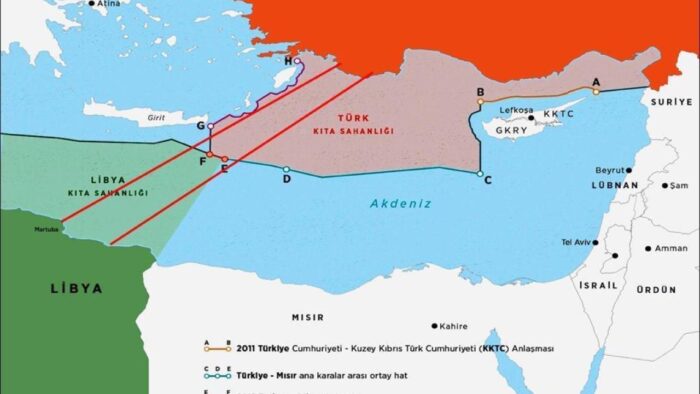
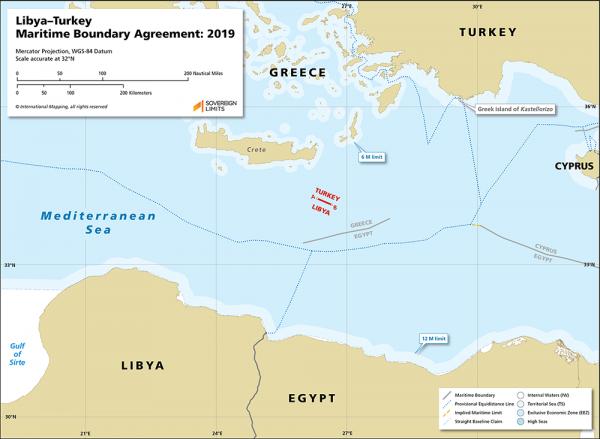
The 2019 agreement attempts to demarcate maritime zones between Turkey and Libya, creating a maritime corridor in the Eastern Mediterranean.
The main point of contention concerns the treatment of the Greek islands, especially Crete, Rhodes, Karpathos and Kasos.
The Greek side argues that this specific demarcation ignores the rights of the islands to a continental shelf and an Exclusive Economic Zone (EEZ), as provided for by the International Law of the Sea.
Turkey, on the contrary, argues that the agreement serves the legitimate rights and interests of the two states, citing the principles of international law and justice.
The dispute is of particular importance because it concerns areas of potential energy interest, as well as maritime corridors through which important infrastructure is planned to pass.
In 2020, Greece and Egypt signed an agreement to partially delimit the EEZ, which was a key diplomatic step for Athens against Turkish claims.
New Turkish NAVTEX south of Rhodes and east of Crete
Almost simultaneously with the Libyan parliament's decision, Turkey issued a new NAVTEX, number 1032/26, to conduct geophysical surveys in the Eastern Mediterranean.
The announcement concerns the research vessel KOBI RUEGG, which is scheduled to carry out work on the submarine cable data transmission system East to Med Data Corridor (EMC).
Work was scheduled to begin on October 21, 2026.
Turkish NAVTEX includes sea areas south of Rhodes, east of Crete and west of Cyprus.
The particularly important element is that Ankara presents the work as activities that have been coordinated and approved by the relevant Turkish authorities.
In this way, it asserts its own claims of jurisdiction in areas where Greece and the Republic of Cyprus dispute Turkish jurisdiction.
It should be clarified, however, that the issuance of a NAVTEX does not in itself constitute proof of sovereignty or sovereign rights. It is primarily a maritime announcement regarding activities and safety issues at sea.
Also, the Turkish wording regarding approval of the work does not automatically prove that the company or the research vessel actually requested permission from Turkey.
This new development adds to the disputes over the region's undersea projects, including the Greece-Cyprus electricity interconnection, known as the Great Sea Interconnector. However, this is a different project from the EMC data transmission cable.
The Greek response with anti-NAVTEX
Athens reacted immediately to the Turkish announcement.
A Greek anti-NAVTEX was issued through the Heraklion hydrographic station, which questioned the competence of the Turkish station in Antalya to issue announcements for the specific areas.
The Greek Hydrographic Service pointed out that the vast majority of the coordinates included in the Turkish NAVTEX are located within the Greek continental shelf, in accordance with the Greek position and the International Law of the Sea.
The exchange of the two announcements shows that the confrontation is not limited to the diplomatic level, but also affects the way the two countries deal with activities at sea.
The Greek side seeks to make it clear that it does not accept the creation of faits accomplis through unilateral announcements or activities related to Turkish claims.
Categorical reaction from the Greek Ministry of Foreign Affairs
In an official statement on October 20, the Greek Ministry of Foreign Affairs rejected the decision of the Libyan Parliament.
Athens argued that parliamentary approval does not change the illegal and invalid, according to the Greek position, character of the memorandum.
The Greek Ministry of Foreign Affairs stressed that geography and the rules of the International Law of the Sea are not changed by unilateral parliamentary decisions.
At the same time, he reiterated that Turkey and Libya do not have opposing or adjacent coasts that would justify the demarcation that the agreement attempts, given the presence of the Greek islands.
Greece announced that it has informed its partners and allies and that it will take the necessary actions to protect its sovereign rights.
Greek diplomacy also raised the issue at the United Nations Security Council, highlighting the dangers that the agreement may pose to the stability of the Eastern Mediterranean.
The European Union supports Greece and Cyprus
The European Union's reaction was clear.
On October 20, the President of the European Council, Antonio Costa, and the President of the European Commission, Ursula von der Leyen, expressed their disagreement with the decision of the Libyan Parliament.
In their joint statement, they reiterated that the European Union considers the Turkish-Libyan memorandum contrary to the Law of the Sea and that it does not recognize legal consequences against third states.
This was followed, on October 21, by an official announcement from the Council of the European Union, confirming that the European position remains unchanged since 2019.
The European Union also underlined the need to respect the sovereign rights of its member states and to maintain stability in the Eastern Mediterranean.
These positions constitute significant diplomatic support for Greece and Cyprus, but do not mean that the conflict has been resolved.
Greece and Egypt consider extending EEZ agreement
On October 22, another development of particular geopolitical significance was recorded.
Greece and Egypt announced that they are discussing the possibility of extending their Exclusive Economic Zone delimitation agreement eastward, in the direction of Cyprus.
The Foreign Ministers of the two countries, George Gerapetritis and Badr Abdelati, reiterated their opposition to the Turkish-Libyan memorandum.
The agreement signed by Athens and Cairo in 2020 concerns the partial delimitation of their maritime zones.
Its possible expansion would constitute a significant development for the maritime cooperation between the two countries and for the shaping of the diplomatic landscape of the Eastern Mediterranean.
For now, however, these are discussions and not a complete new agreement.
Why the Eastern Mediterranean is becoming increasingly important
Behind the controversy over the Turkish-Libyan memorandum lies a broader set of strategic interests.
The Eastern Mediterranean is an important region for Europe's energy security, maritime transport, undersea cables and the exploitation of potential natural gas deposits.
Turkey seeks to strengthen its regional role, leveraging its relations with Libya and promoting its own positions on the distribution of maritime zones.
Greece, for its part, bases its strategy on international delimitation agreements, cooperation with neighboring countries and the implementation of the International Law of the Sea.
Cyprus and Egypt are also key players in the regional equation, as maritime claims and planned infrastructure directly affect their interests.
The recent shift in eastern Libya adds a new dimension to this already complex geopolitical reality.
The next step and the risks for the region
The latest developments create new data for Greek foreign policy.
The approval of the memorandum by the Libyan parliament does not automatically entail a change in maritime borders nor does it resolve the legal disputes between the states involved.
However, it strengthens Turkey's political position in Libya and may form the basis for new initiatives by Ankara on issues of maritime research and economic cooperation.
For Greece, the main priority remains to safeguard its sovereign rights and prevent actions that could lead to further tension.
Athens' diplomatic mobilization, the support of the European Union, and contacts with Egypt show that the response is developing on many levels.
The coming period will be particularly important to determine whether Turkey and Libya will attempt to turn their political agreement into concrete actions at sea.
The Eastern Mediterranean remains a region where geography, international law and strategic interests meet, without always leading to commonly accepted solutions.
The essential question now is not only who claims what, but how to ensure that competing claims do not lead to a new regional crisis.
Journalistic editing: Greek News & Radio FL
sources
Greek Ministry of Foreign Affairs – Official announcement, October 20, 2026.
European Council – Joint statement by Antonio Costa and Ursula von der Leyen, 20 October 2026.
Council of the European Union – Declaration on the Turkish-Libyan Memorandum, 21 October 2026.
Reuters – Developments in Libya, October 20, 2026, and Greece-Egypt talks, October 22, 2026.
NEWS – Greek anti-NAVTEX, October 21, 2026.
HuffPost Greece – Turkish NAVTEX 1032/26, October 20, 2026.
The maps depict the maritime claims associated with the 2019 agreement, not the exact areas of the new NAVTEX.
Official sources
Turkish-Libyan Memorandum: What is at stake in the Aegean? Baltzoi